Denali #4
2014
I climbed Denali with my good friend, Brady O'Mara.
We trained for nearly a year before we climbed.
There was no support beyond our tea- no Sherpas, no porters. We carried group gear in equal shares: tents, stoves, fuel, food. Brent warned us repeatedly to hold on to everything. Losing a bag out here wasn’t just inconvenient; it could end someone’s trip. That night Brady confided that he felt ill, that the day had been brutal, and that he was thinking of turning back. Brent told him to sleep on it, and we’d reassess in the morning. The cooking tent -a parachute rigged over a dug-out hole with a pole down the middle - was our communal kitchen. Melting snow at 8–9,000 feet takes a lot of BTUs; multiple stoves burned for a few hours each night and morning.
Morning brought a new day and new perspective. We were to move gear higher, cache it, and return to camp to sleep lower. Brady had decided that he wasn’t ready to give up. Day two was mostly uphill toward the glacier, less windy but a steady grind. We alternated positions in the line, swapping the lead as the slog demanded. Carrying our heavy packs and pulling our sleds we were all new to this hard work. We shared stories to keep spirits high: teammates from Florida, Buffalo, Kentucky. At roughly 9,600 feet we cached gear and returned to the lower camp. Climb high, sleep low, acclimatize. It was basic, uncomfortable, and necessary.
The following day we pushed to base of Motorcycle Hill - at 11,200 ft - then spent time practicing self‑arrest, donning crampons and sorting gear. Everyone seemed okay, at least on the surface. From there we climbed Motorcycle Hill, followed Squirrel Hill, and threaded the windy corner to the polo field at the foot of the West Buttress; the elevation was almost 13,300 feet. We stopped at Windy Corner for people to add a layer due to the cold. I stupidly removed my gloves to adjust a strap and just like that I developed frost nip of my fingertips! No time to dwell, we continued to our destination and cached our gear, returning to 11,000 feet to rest for another mandatory acclimatization day.
Denali
Denali was the fourth of the Seven Summits for me . This would be the second peak that my buddy, Brady, and I would do together. We’d spent more than a year slogging through Valley Forge Park, the Wissahickon, and Ridley Creek—pulling bike trailers, shouldering heavy packs, learning how our bodies moved under load. Neither of us were seasoned mountaineers, though both of us had climbing experience: Brady had done a Denali training camp on the Kalhitna Glacier two years earlier; I’d gone to British Columbia for crevasse rescue training in the Columbia Icefields the year before. Denali would be our biggest multi-glaciated mountain and, we both suspected, the biggest challenge we’d faced.
We flew into Anchorage and met our RMI team and guides. Brent Okita was our lead guide -calm, experienced, and unflappable - and he and his assistant guides set the tone. We drove four hours to Talkeetna, a tiny mountain town built around one main street and a tiny airfield. I remember stopping at a supermarket on the way;nour group swarmed every package of Smucker’s “Uncrustable” sandwiches plus cheese, salami, and anything else to supplement the snack food we’d packed. In Talkeetna we spent a few days doing gear checks and waiting for weather. When the green light came, we boarded a twin‑engine Otter that buzzed along the Alaskan ranges and dropped us onto the Kahiltna Glacier and Denali Base Camp.
The flight was short and spectacular. On the ground, Brent had already tucked a case of beer into the snow with a little flag - our celebration to be opened on our return. We barely unloaded before we were donning our snowshoes, packing sleds and pulling on our pack shoulder straps and heading for Camp One. The first part of the route dropped us, then climbed. The headwind pushed at us, sleds grinding through hard‑packed snow. It felt like the whole afternoon before we reached the base of Ski Hill and the small plateau where we’d set camp.
Weather controlled the mountain. Teams shuffled like chess pieces waiting for a break. We watched the Park Service whiteboard daily, checking the forecast and the ranger’s notes. Some teams were stuck for days, running low on food; others chose to descend because conditions never allowed a summit push. Brent believed we were stuck under an inversion and that the weather above would be better. We trusted him.
When the window came, we carried up fixed lines on the West Buttress to cache food and gear. For several of us this was new. One teammate, terrified on the fixed line, clung to my rope rather than the anchors, adding another 170 pounds to my load. In some places where I had to yell for him to use the fixed line his fear made an already dangerous situation worse. But, we managed to get the caches in and return to 14,000 feet in one piece.
We spent four days camped at 14,000 feet under a paranoid, patient rhythm: build walls, clear snow off tents, walk out to look at the weather, check the whiteboard. On day five the weather eased and moved camp. We carried our remaining gear up the fixed lines to the col on the West Buttress. Conditions deteriorated as we climbed; visibility shrank, and the wind spiked. At the top of the West Buttress Brent made a call to bivi on a small, icy, sloped patch rather than continue into a stronger wind. We dug a platform and squeezed tents into the limited space - four people into a three‑person tent. The night was long, wind battering, tents groaning. Two guys in our tent said they would turn back if they survived the night. I remember the fear and the absurd, childish laughter that tried to make the night less real. I was never happier to be in the middle, cushioned by warmth on both sides.
Dawn blew the storm away. We packed and moved to High Camp at 17,000 feet, climbing into calm, cold clarity. The route was technical - steep sections, cramponed steps, roped glacier travel. One team member still struggled with the ropes and carabiners, slowing the group. But the thin air felt less cruel with the sun slicing across the glacier. We settled in at High Camp, waited for the guide’s briefing, and learned that a couple of men had been asked to stay back; the guides had judged them not safe for the final push. Brady and I were ready.
Cont.
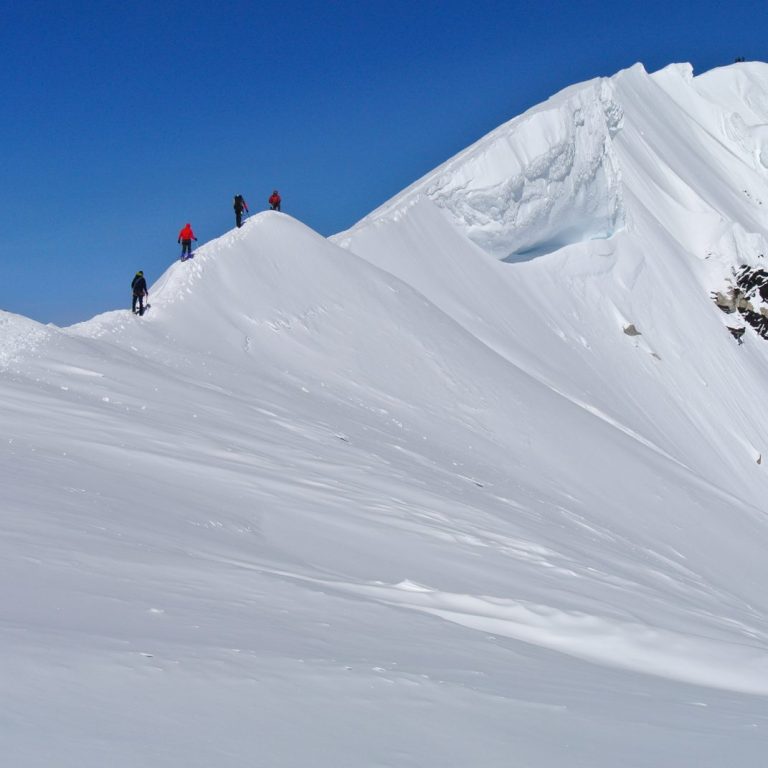
Denali’s summit day doesn’t follow the alpine pattern of leaving at night for dawn summits. Here you leave in the morning and break the day into methodical stages. We carried light packs: layers, food, water, just essentials. The traverse out from camp exposed us immediately; the blue glow of the glacier, rimed seracs—beautiful and serious. We climbed steeply to the Audubon, then pushed for Denali Pass at 18,200 feet. From there the route climbs the ridge to the football field at about 19,200 feet. I began to lose steam. Not nauseous, not dizzy—just hollow and slow. I’d probably under‑eaten and under‑drank. Brady was ahead, moving well; the distance between us grew. He didn’t wait, and I didn’t expect him to. I kept going at my own pace.
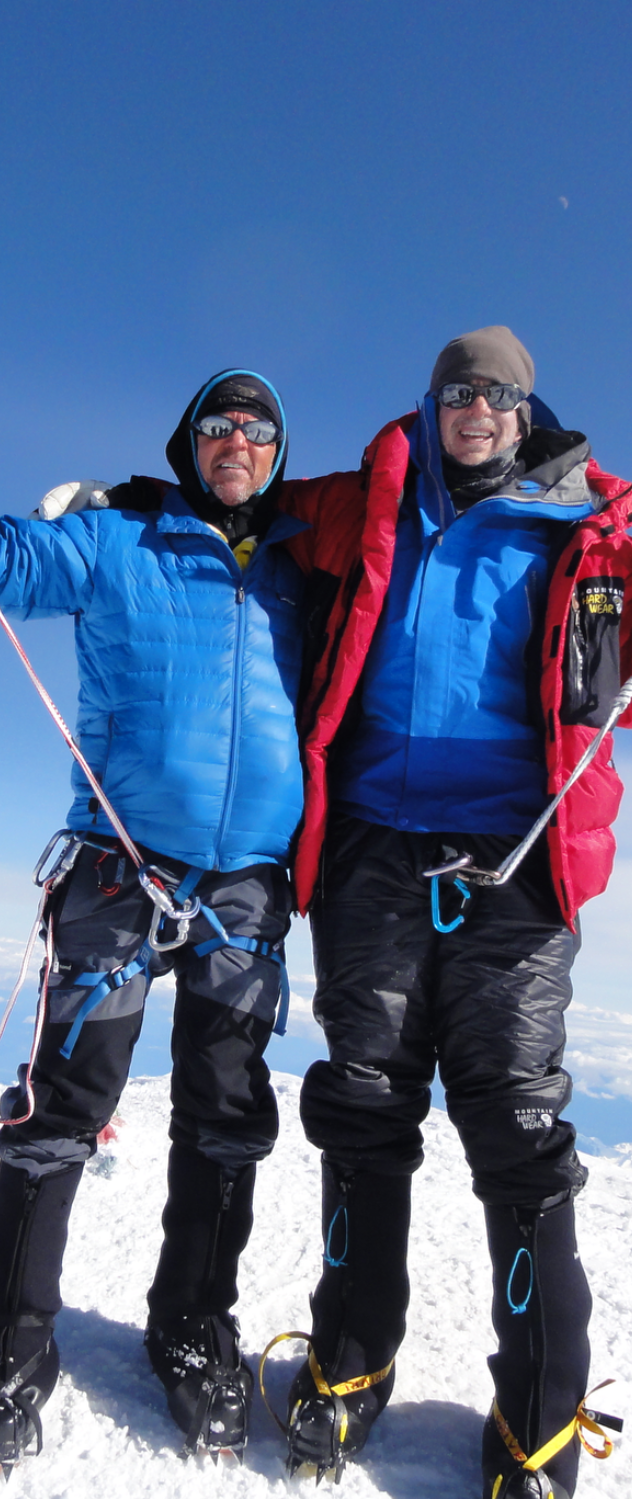
The team waited at the top of Pig Hill, and from there we threaded the summit ridge. I needed a short rope and Brent’s steady hand to get me up the final hump. When I stood on Denali, I felt everything that had led me there—training days, small humiliations, the long slog across Alaska’s white world. We hugged, posed with flags, took photos. It was as much relief as triumph.
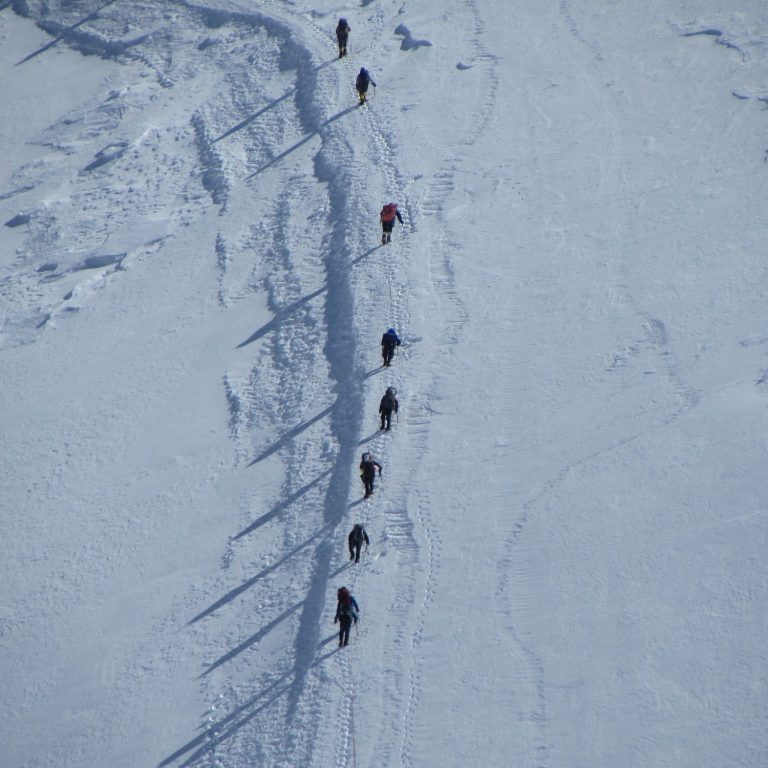
Descending felt slick with new danger. On those long mountain descents the guides often work from the back to keep the rope line anchored. Our roped team was five; I was third. At one traverse—a 3,000‑foot exposure below Pig Hill—the climber behind me lost control. He started to pendulum and the guide behind him went with him. “Falling!” he shouted. My training kicked in. I hammered my ice axe, drove my cramponed boots into the snow and dug in with everything I had. I couldn’t see the pair behind me, only feel the jerk through the rope. I shouted, “Are you okay? Are you okay?” The others in front of me did the same. The anchor held. It felt like a long minute before the pressure eased and Leah, the guide, called back, “Bruce, you can stand up.” When I looked behind, both of them were panting and trembling but smiling—they mouthed thanks.
The rest of the descent was a slow unspooling. My legs locked up, my energy vanished. I’d been the last to the summit and the last back to High Camp. The team members that had stayed behind met us there, hugs and quiet congratulations. Leah pulled me aside and thanked me for holding—told me how my actions probably saved a life. I couldn’t have felt prouder.
We still had miles to go. From High Camp we descended to 14,000 feet, but we were held up for hours while a teammate cramped on the fixed lines. Standing on a 55-degree slope tied to a fix line and standing in the cold was no one’s idea of a celebration. We made it down to 14,000 ft camp and spent the night. The next day it was down to 11,000 feet where sleds became usable again. Sleds are great on the flat; on steep, uneven snow they roll, tangle, and pin you. My feet—inside my double plastic boots—began to bind and sweat. Blisters blossomed. By the last day, trudging the final rise to the Kahiltna base camp, I moved like a turtle. I kept thinking about the case of beer Brent had hidden in the snow. When we reached that flag, we opened the beer with great excitement. We got luck with an afternoon flight to Talkeetna. We were once again in the forest. Talkeetna, the sight of green struck me harder than any summit photo.
It was in Talkeetna, under a real roof, that I discovered the extent of the damage: trench foot, windburn, early frostnip on my nose and fingertips. I’d thought I had taken every precaution; the mountain had its own plans. Still, that night we ate pizza until we could eat no more, drank the beer we’d earned, and slept—collapsing into beds that felt like treasure after nineteen days under nylon and on top of ice.
Denali taught me how fragile margin is on a big mountain: how quickly weather, fatigue, and fear can unbalance a team; how small, trained actions—hammering a pick, dropping into a three‑point anchor—can make the difference between catastrophe and continuation. It was the fourth summit in our quest, but it felt like a rite of passage. Brady and I left Alaska quieter, humbler, and strangely more certain that we could keep going.